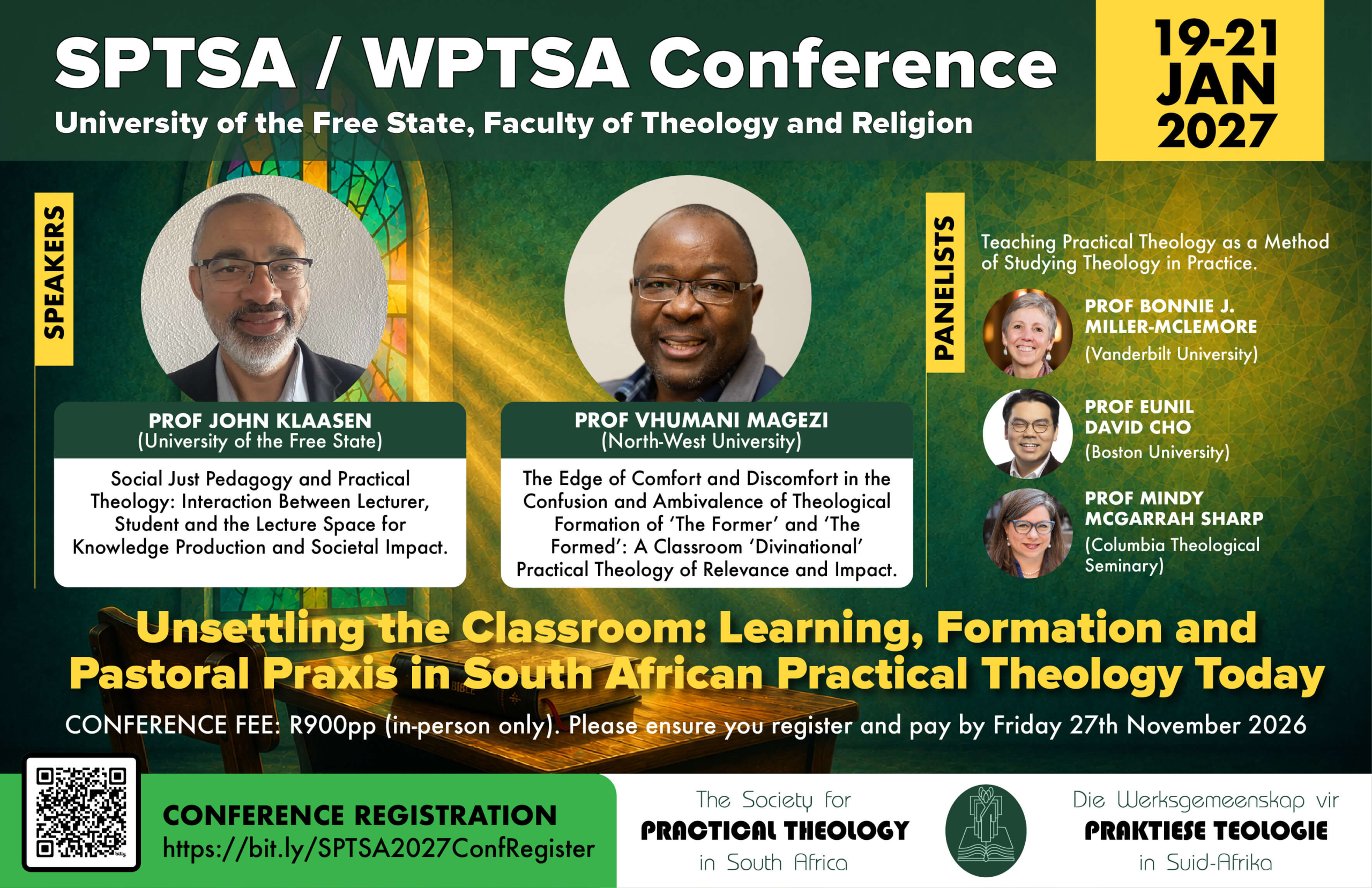
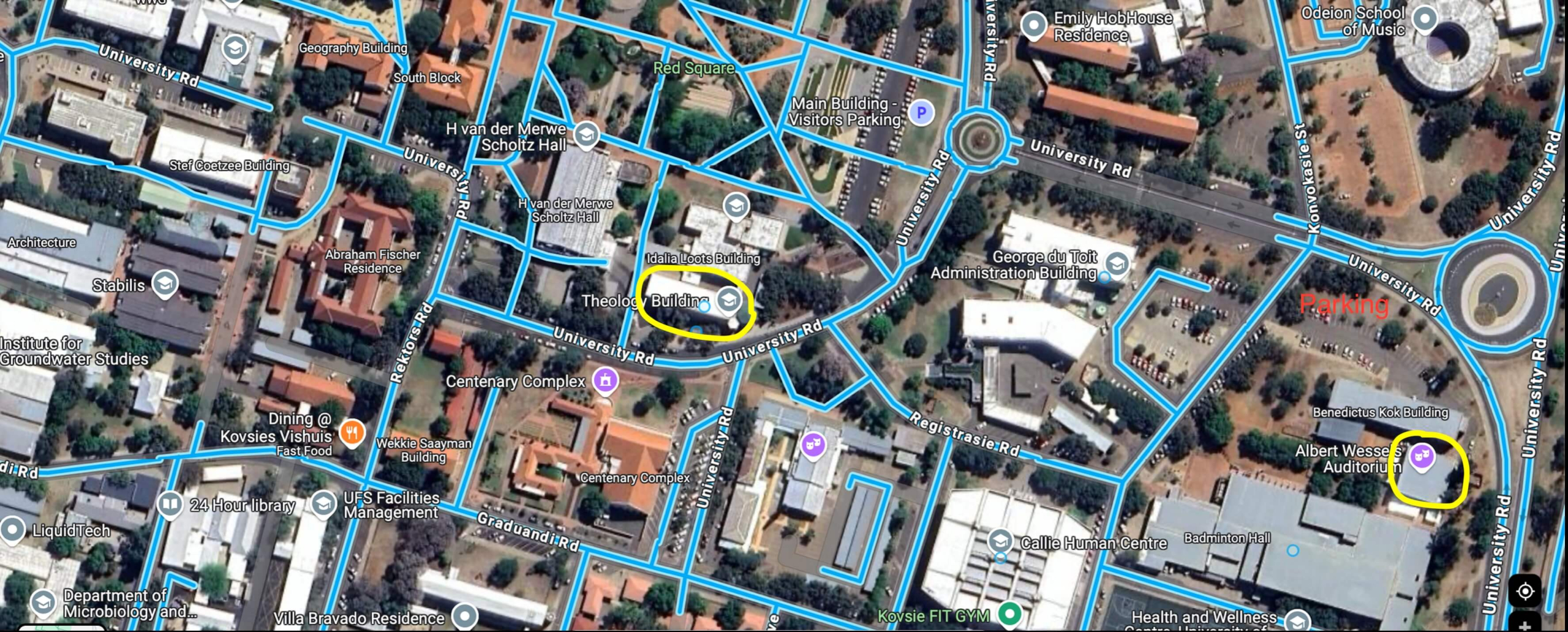
Our SPTSA 2027 Conference will be held at the University of the Free State in Bloemfontein from 19 to 21 January.
Theme: “Unsettling the Classroom: Learning, Formation, and Pastoral Praxis in South African Practical Theology Today”
- Introduction
The Society for Practical Theology in South Africa is pleased to announce the call for papers for its Annual Conference to be held in January 2027 at the University of the Free State.
In contemporary South Africa and the wider global context, theological education and ministerial formation take place within deeply fractured social realities marked by inequality, violence, gender injustice, migration, mental health struggles, ecological crises, spiritual searching, and ongoing debates concerning decolonisation and transformation. Within these realities, the theological classroom cannot be understood as a neutral or detached space of knowledge transmission. Rather, it is a contested, embodied, pastoral, and transformative space where identities, epistemologies, faith commitments, and vocational imaginaries are continuously negotiated.
This conference seeks to critically explore how Practical Theology responds to the challenges and possibilities of teaching, learning, formation, care, preaching, worship, and praxis in South Africa today. The conference particularly invites conversations that unsettle inherited pedagogies, homiletical traditions, dominant theological assumptions, and exclusionary practices while imagining more life-giving, contextually grounded, and justice-oriented approaches to theological education and ministerial formation.
The conference recognises that classrooms, pulpits, counselling rooms, worship spaces, and communities are interconnected sites of theological formation and praxis. Contributions are welcomed from across the sub-disciplines of Practical Theology, including pastoral care and counselling, homiletics, liturgy, spirituality, youth ministry, missiology, public theology, theological education, feminist and womanist theology, and related interdisciplinary fields.
- Literature Review and Thematic Framing
The theme “Unsettling the Classroom: Learning, Formation, and Pastoral Praxis in South African Practical Theology Today” emerges from ongoing scholarly concerns regarding the nature and purpose of theological education within contexts marked by inequality, social fragmentation, decolonial struggles, and pastoral complexity. Naidoo (2012:1, 2) argues that theological education should not merely transmit theological knowledge but should holistically form leaders who possess spiritual maturity, moral integrity, relational competence, and the capacity to respond to the pastoral realities of society. Theological formation therefore involves more than academic achievement; it entails vocational discernment, ethical leadership, and contextual responsiveness. Similarly, Githuku (2004:227-229) critiques theological institutions that privilege intellectual formation while neglecting practical ministerial competence, resulting in graduates who are disconnected from congregational and community realities. These concerns directly relate to the conference theme by challenging theological educators to rethink classrooms as transformative spaces of embodied learning, formation, and praxis rather than neutral sites of knowledge transfer.
The conference theme also resonates with broader conversations concerning engaged scholarship, decolonisation, embodiment, and public responsibility in theological education. Njoroge (2004:84) insists that theological curricula in Africa must be contextual, ecumenical, socially relevant, and attentive to the historical and socio-cultural realities of African communities. Barker (2004:128-132), together with Petersen and Osman (2013:4), further emphasises that higher education institutions have a responsibility to cultivate socially engaged learning, community partnerships, and participatory knowledge production oriented toward justice and the common good. Within Practical Theology, Dames (2018) highlights the challenge of maintaining the theological identity of pastoral care amid changing societal needs, while Wepener (2012:2) demonstrates how liturgical and ritual studies increasingly require interdisciplinary and contextually grounded approaches. Discussions on gender, sexuality, vulnerability, and decolonisation further reveal that theological classrooms are contested spaces where identities, traditions, power, and faith commitments are negotiated. Consequently, the conference invites critical reflection on how Practical Theology can unsettle inherited pedagogies and practices in order to cultivate transformative learning, inclusive formation, and contextually grounded pastoral praxis in South Africa today.
- Working Groups and Sub-Themes
Working Group A: Teaching and Learning
Decolonising Theological Education
- Decolonial pedagogies and transformative theological learning
- Contextual theological curricula in African realities
- Formation for ethical and socially responsive leadership
- Critical and embodied learning in theological classrooms
Working Group B: Embodiment, Gender, Sexuality, and Vulnerability
- Gender and sexuality in theological formation
- Embodied learning and vulnerability in ministry formation
- Religion, culture, and inclusion in theological classrooms
- Pastoral responses to gender-based violence and exclusion
Working Group C: Pastoral Care and Counselling
- Pastoral identity and theological formation
- Mental health, trauma, and care in South African contexts
- Contextual pastoral praxis in fractured communities
- Integrating theology and counselling in ministerial formation
Working Group D: Faith Formation
- Spiritual formation and ministerial identity
- Faith formation in multicultural and diverse contexts
- Vocational discernment and leadership development
- Congregational formation and transformative discipleship
Working Group E: Missional and Public Praxis
Community-Engaged Learning
- Community-engaged theological education
- Public theology and social transformation
- Service learning and contextual ministry praxis
- Missional leadership and justice-oriented formation
Working Group F: Worship, Homiletics, and Spirituality
- Contextual preaching in contemporary South Africa
- Worship as a space of formation and transformation
- African spirituality and liturgical praxis
- Ritual, embodiment, and pastoral imagination
Working Group G: Youth, Identity, and Formation
- Youth identity and theological formation
- Digital culture, spirituality, and learning
- Youth ministry in contexts of inequality and vulnerability
- Student activism, belonging, and faith formation
References
Barker, D.W. 2004. The Scholarship of Engagement: A Taxonomy of Five Emerging Practices. Journal of Higher Education Outreach and Engagement, Vol 9 (2):123-137
Dames, G.A., 2018, ‘The professionalisation of pastoral care-giving: A critical assessment of pastoral identity within the helping professions’, PHD in Practical Theology with specialisation in Pastoral Therapy, University of South Africa.
Githuku, S. 2004. Challenges of Theological Education in the 21st Century. In: Galgalo, J. D. & LeMarquand, G (Eds.). Theological education in contemporary Africa. Zapf Chancery, Eldoret, Kenya, pp. 227-236.
Naidoo, M. 2012. Introduction. In: Naidoo, M. (Ed.). Between the real and the ideal: Ministerial formation in South African churches. Ministerial formation in Southern African Churches. Unisa Press: Pretoria, pp. 1- 14.
Njoroge, N.J. Ecumenism and Theological Education. 2004. In: Galgalo, J. D. & LeMarquand, G (Eds.). Theological education in contemporary Africa. Zapf Chancery, Eldoret, Kenya, pp 83-104
Petersen, N., & Osman, R. (2013). An Introduction to Service Learning in South Africa. In: Osman, R & Petersen, N (Eds.). Service Learning in South Africa. Oxford University Press: Cape Town, pp. 2-32.
Wepener, C. 2012. Reflections on Recent Developments in Liturgical Studies in the Light of Experiences from the Research Field and the Lecture Room. Journal of theology for Southern Africa Vol 144(1):1-13